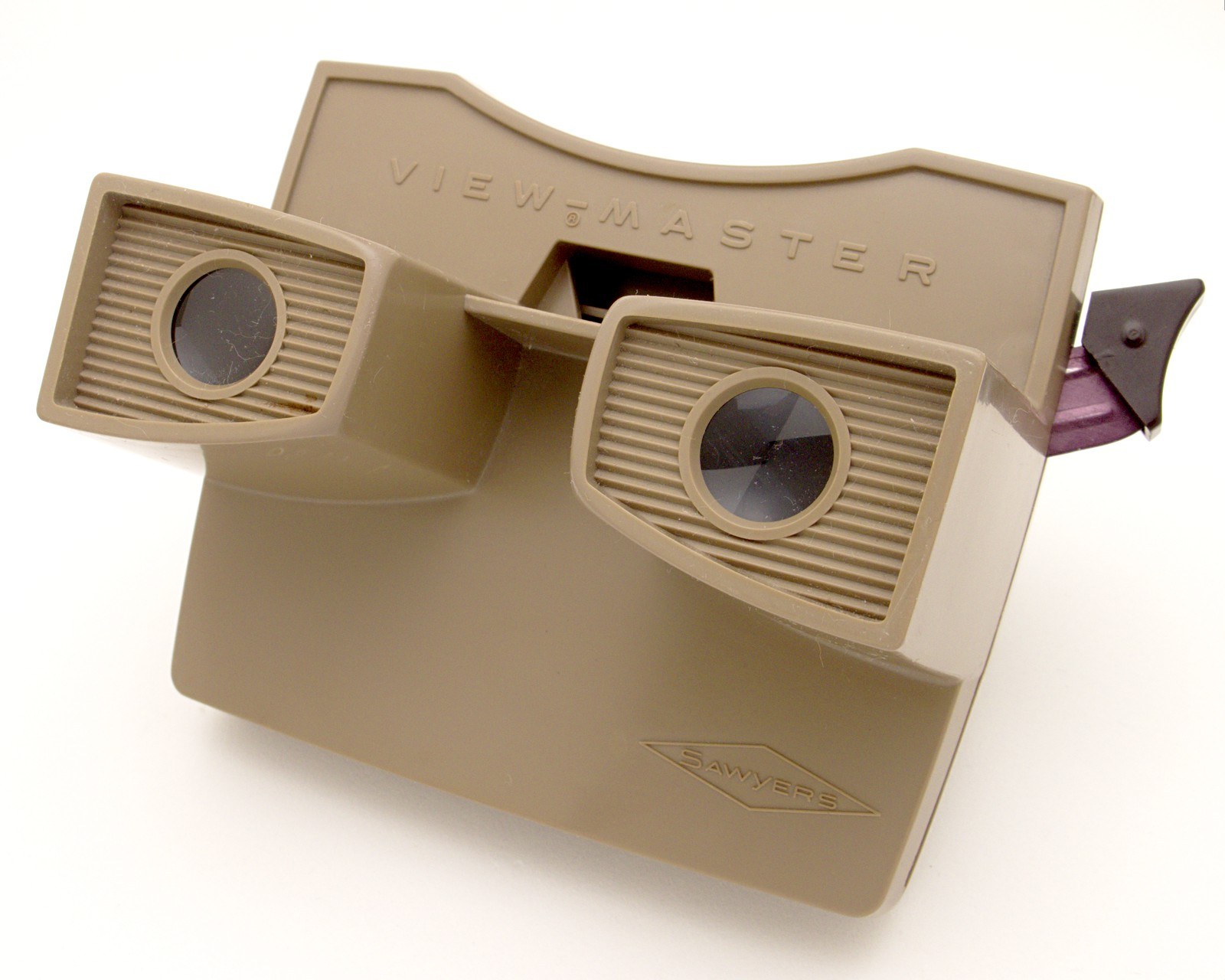

Hold the viewer to your eyes, find the light, and an ordinary room briefly gives way to somewhere else. A landscape seems to open in front of you. A familiar character occupies a little scene with depth. Then a movement of the lever changes the view, and the small journey continues without anyone leaving the chair.
Sightseeing came before the toy box
The Strong National Museum of Play traces the View-Master to William Gruber and Harold Graves and its introduction at the 1939 New York World’s Fair. Early reels featured scenic attractions. The museum’s history also describes how entertainment licensing later expanded the selection, helping connect the viewer with the characters and stories children recognized.
That beginning makes the object interesting in more than one way. It could be a souvenir, a way to look at distant scenery, or a toy associated with a favorite story. The same basic action served different kinds of curiosity. A place you had visited and a place you could only imagine could both arrive on a small reel.
Looking required a little attention
The viewer asked you to arrange yourself around the picture. Find a useful direction for the light. Set the reel correctly. Hold the eyepieces comfortably. Those small adjustments were part of reaching the image. Once it appeared clearly, the surrounding room became less important for a moment.
The lever supplied a satisfying punctuation mark. One scene ended, another began, and the movement itself confirmed the change. You could move quickly through the sequence or stay with a particular view. Reaching the beginning again made the collection feel complete, ready to be revisited rather than disappearing after one use.
A private view you wanted to share
Only one person could look through a single viewer at a time, which made sharing slightly different from watching television together. You handed over the whole experience. The next person had to find the same scene and see it for themselves. An excited explanation often arrived before the viewer did.
A small stack of reels could become a collection with its own favorites. The printed sleeves and titles helped organize what was inside, but repeated use made some scenes recognizable without reading anything. The most familiar reel might be the one connected with a trip, a gift, or the person who first showed you how the viewer worked.
Screens now offer endless moving pictures, yet the old viewer retains a particular charm. Its world was bounded and physical. You could remove one journey and insert another, knowing exactly where each was stored. A cardboard circle and a simple click were enough to make looking feel like an activity of its own, with room for curiosity between one image and the next.
Did your favorite reel show a real place or a fictional world?
Sources & further reading
Written with AI assistance. Historical details checked against the linked sources. Our editorial approach
Keep a little yesterday close